

If you want anyLogistix tables to show only certain records, filter the data in the corresponding column(s) of the table by providing the filtering equation into the filter cell below the column title:
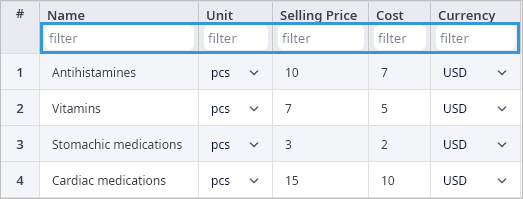
You can filter data by:
Apart from the plain text the filter field also accepts:
-
Operators:
- (>0) — greater than the specified value.
- (<0) — less than the specified value.
- (=0) — equal to the specified value.
- (>=0) — greater than the specified value or equal to it.
- (<=0) — less than the specified value or equal to it.
- true / false — boolean values.
- and — [available within filters of certain tables only] the logical and operator.
- or — [available within filters of certain tables only] the logical or operator.
- : — [available within filters of certain tables only] the colon specifies the search query by excluding the matching text values from the output. It may also act as a divider.
-
Variables and expressions (within filters of certain tables only):
- assigned name — filters the records by the Assigned name defined in the Left-Hand Side column of the Custom Constraints table.
- unassigned — returns the empty records. These are the records that have no type assigned to them. This is possible only for the new records that have not been edited.
-
variable — filters data by the variables.
If required you can filter by the specific variable:
- continuous — returns the records with the Continuous variable.
- integer — returns the records with the Integer variable.
- semi-continuous — returns the records with the Semi-continuous variable.
- boolean — returns the records with the Boolean variable.
-
expression — filters data by the expressions.
If required you can filter by the specific expression:
The expression keyword can also be used in the Expression column of the Linear Ranges and Objective Members tables.
- linear — filters data by the Linear expression type.
- min — filters data by the Min expression type.
- max — filters data by the Max expression type.
- step — filters data by the Step function type.
- limit — filters data by the Limit inputs and Limit outputs types.
- intputs — filters data by the Limit inputs type.
- outputs — filters data by the Limit outputs type.
- piecewise — filters data by the Piecewise function type.
To filter table records by the more, less, etc. conditions
-
Click the filter cell below the Selling Price column title and type in the desired condition.
We will type in a less than condition (<7).
The column data will be filtered according to the specified condition:
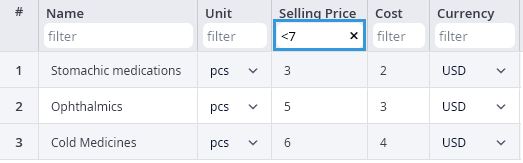
In the same way you may filter the data column according to all other conditions.
-
To remove the filter, simply click the
 icon to the right of the specified condition (<7).
To filter table records by text
-
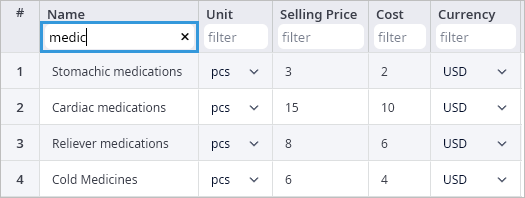
Click the filter cell below the column title and type in the text that will be used to filter the column data.
In our case we filter the data in the
Name column by medic to see all possible options.
The column data will be filtered according to the specified text:
-
To remove the filter, simply click the
icon to the right of the medic value.
To filter table records by the explicitly specified numeric value
-
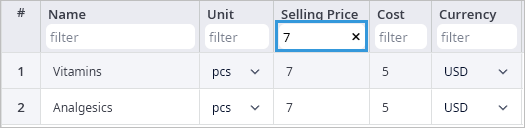
Click the gray cell below the Selling Price
column title and type in specific numeric value (7)
that will be used to filter the column data.
The column data will be filtered according to the specified numeric value:
-
To remove the filter, simply click the
icon to the right of the specified numeric value
7.
For cells containing both time and date values, the filter accepts complex requests (e.g. mm/dd/yy hh:mm) with operators, if required.
To filter table records by date
-
Click the filter cell below the column title and type the desired date in any of the following formats:
- yyyy
- yyyy-mm
- yyyy-mm-dd
- m/d/yy
- mm/dd/yy
-
To remove the filter, simply click the icon to the right of the specified value.
To filter table records by time
-
Click the filter cell below the column title and type the desired time in any of the following formats:
- hh or hh:mm — if you prefer to create filter request in the 24-hour time format.
- hh:mm AM/PM — if you prefer to create filter request in the 12-hour time format.
-
To remove the filter, simply click the icon to the right of the specified value.
Table columns may contain toggle buttons as a type of data that a user and anyLogistix use for scenarios. The toggle buttons define whether the certain data will be included or excluded from the scenario (or switching between certain states e.g. straight routes/actual routes).
-
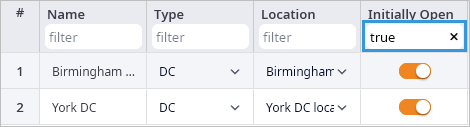
Click the filter cell below the column title and type in
true or 1 if you want to filter by the enabled records, and
false or 0 to show the disabled records:
-
To remove the filter, simply click the
icon to the right of the specified condition.
Records of certain tables (Custom Constraints, Linear Ranges, Objective Members) contain complex data comprising variable types, names of variables, and coefficients. The filters of the table columns containing these records accept additional data.
Put the : colon symbol after the variable / expression to search by their type. If the search is done without the colon, the filter will search for the matching text value as well.
If additional value is added to the search query after the colon (when searching for both variable and expression) the variable will be excluded from the output, since it does not contain a custom constraint that could contain the requested value. As for instance, the existing records with the boolean variable will not be present in the output of the following query: boolean, linear: total cost. But they will be present in the output of the following query: boolean, linear:.
The filter searches for numeric values only in the names of custom constraints (initially defined in the Left-Hand Side column). The search output in the Right-Hand Side column will list records with expressions that contain custom constraints with the matching numeric values in their names.
A two-step filter has been implemented to provide a more convenient search that can filter data by various types of values:
- The first step is to search by the keyword defining the type of expression / variable.
- The next step is to search by the objects that the specified type contains.
The basic search query may look like this: type_name [, type_name]: "filtered_value" [AND / OR "filtered_value"], where:
-
type_name — the name of the expression / variable type.
The types are filtered by their full names only, i.e. the output for the max expression variable type will be empty if the query contains ma instead of max.
- [, type_name] — other types the search output must contain (a combination of several types is possible, if required). The comma in this case acts as the logical operator OR.
-
"filtered_value" — the value the search will be looking for within the expression.
The quotation marks are necessary only If the inserted search value is a combination of keywords with the AND or OR operators.Due to the peculiarities of the default groups of objects (All customers, All sites, All suppliers) the search by groups of objects is done by the groups' full names only (refers to Limit inputs and Limit outputs).
- [AND / OR "filtered_value"] — use these logical operators and parentheses to create a more complex search query with additional values. The quotation marks are obligatory for the query keywords if the logical operators are used.
-
: — use the colon to filter data by variable / expression type and exclude the matching
text values from the search output.
In a complex search query (with commas, logical operators) the colon acts as a divider between the types and the values.
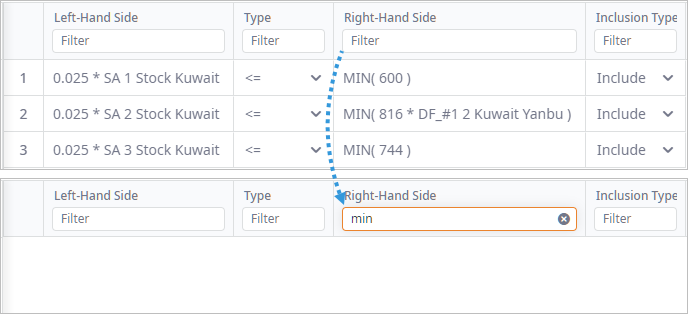
The image below shows the filter output for the min filter parameter.
The output contains two records: one with the matching text value, the other one with the Min expression variable type.
However, if you filter by min: the output will contain only 1 record that has the Min expression variable type:
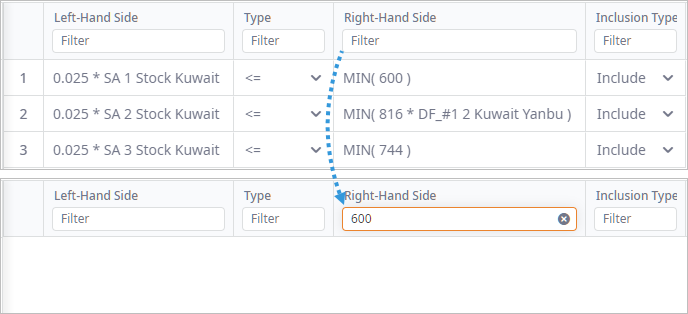
Filters of such columns accept numeric values only for the name of the variables:
To create a more specific filter add the and and or operators allowing you to combine several requests into a more complex one.
To filter table records by the expression type
-
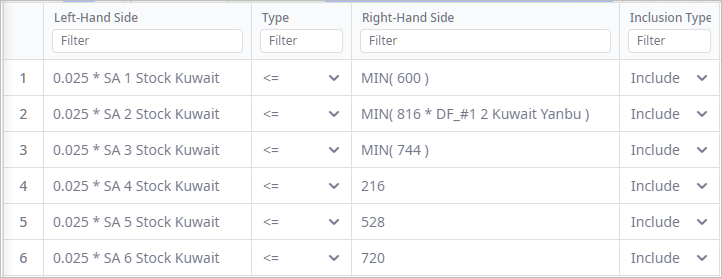
Open the Custom Constraints table:
-
Click the filter cell below the Right-Hand Side column title and type linear: to filter records by the
Linear expression variable type.
It is important to use the : colon symbol, if you want to exclude the matching text values from the search output and filter by the variable / expression type only.
-
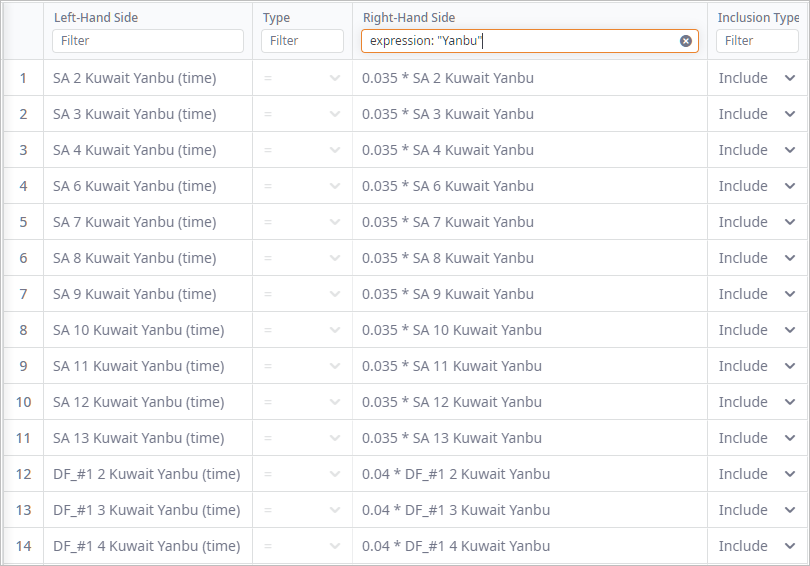
Now press Space and type "Yanbu" to additionally filter the records by this customer:
-
There is still plenty of data to look through.
We are interested in flows SA 2 or SA 3, so we will create the required request by adding the logical
and operator and the request itself ("Sa 2" or "Sa 3"):

-
How can we improve this article?
-